
- Main Day of Diwali 2026: Sunday, November 8, 2026
- Festival runs: Friday, November 6 – Tuesday, November 10, 2026
- Lakshmi Puja (peak celebrations): Night of Sunday, November 8
- Dhanteras (Day 1): Friday, November 6, 2026
- Bhai Dooj (final day): Tuesday, November 10, 2026
Known universally as the Festival of Lights, Diwali 2026 (or Deepavali) is one of the most significant and joyous religious festivals in the world, celebrated by over a billion Hindus, Jains, Sikhs, and some Buddhists.
The festival symbolizes the spiritual victory of light over darkness, good over evil, and knowledge over ignorance. Because the dates are determined by the Hindu lunar calendar, the festival shifts every year on the standard Gregorian calendar, typically falling between mid-October and mid-November. If you are preparing to celebrate, clean your home, or book travel, here is your complete guide to Diwali 2026.
When Is the Main Day of Diwali in 2026?
The most important night of the festival, known as Lakshmi Puja, always falls on the darkest night of the lunar month (the new moon, or Amavasya).
In 2026, the main day of Diwali will be celebrated on Sunday, November 8, 2026.
Because the primary celebration falls on a Sunday this year, communities across the globe will have the entire weekend to host large gatherings, set off fireworks, and share feasts without having to take time off from the traditional Monday-to-Friday workweek!
The 5-Day Diwali 2026 Calendar
While the main event is on Sunday, November 8th, Diwali is actually a sprawling five-day festival. Each day holds its own unique significance and rituals. Here is exactly how the 2026 calendar breaks down:
| Day | Name | 2026 Date | Key Ritual |
|---|---|---|---|
| Day 1 | Dhanteras | Friday, November 6 | Buying gold, silver & new utensils |
| Day 2 | Choti Diwali / Naraka Chaturdashi | Saturday, November 7 | Lighting diyas & making rangoli |
| Day 3 ⭐ | Diwali & Lakshmi Puja | Sunday, November 8 | Main puja, fireworks & feasts |
| Day 4 | Govardhan Puja | Monday, November 9 | Annakut food offerings |
| Day 5 | Bhai Dooj | Tuesday, November 10 | Celebrating the brother-sister bond |
Day 1: Dhanteras (Friday, November 6, 2026)
The festival officially begins! This day is dedicated to cleaning the home and welcoming prosperity. It is considered highly auspicious to purchase gold, silver, or new kitchen utensils on Dhanteras. The word “Dhan” literally means wealth in Sanskrit, and families across India and the diaspora flock to markets for new purchases believed to bring Goddess Lakshmi’s blessings into the home.
Day 2: Choti Diwali / Naraka Chaturdashi (Saturday, November 7, 2026)
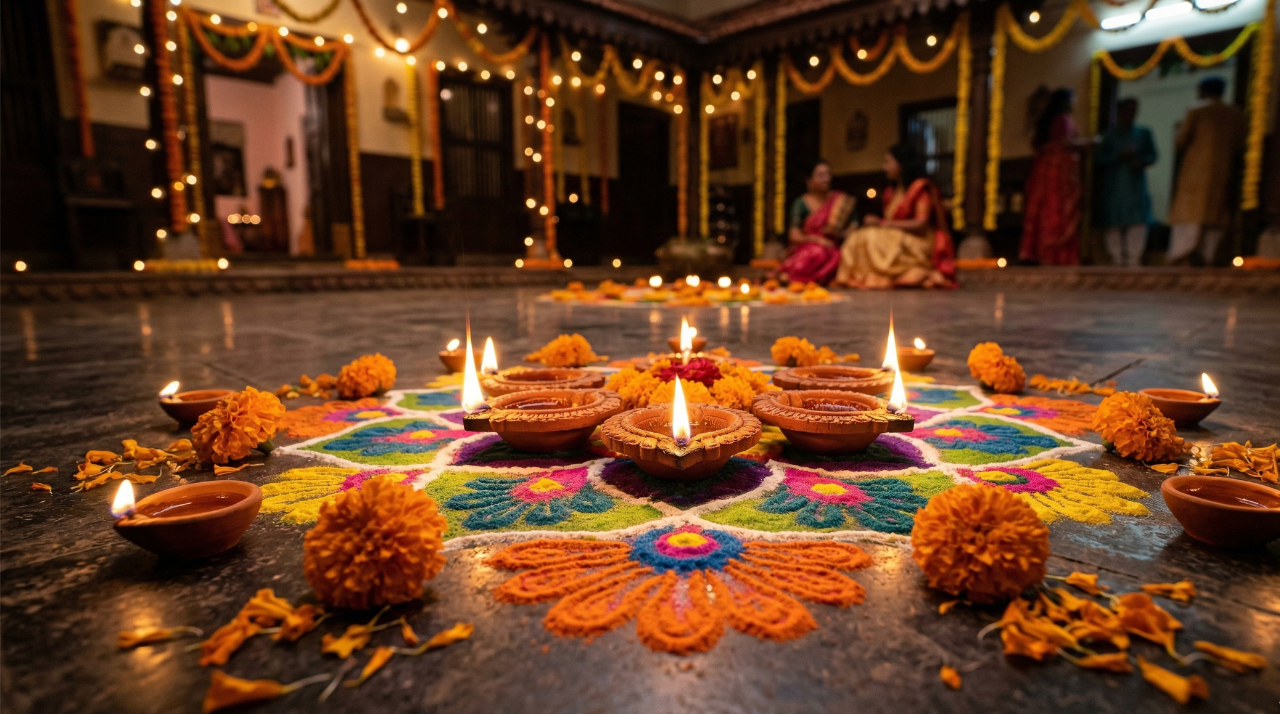
Known as “Small Diwali,” this day commemorates Lord Krishna’s victory over the demon Narakasura. Families begin decorating their homes with clay lamps (diyas) and creating colorful rangoli patterns on the floor. In many South Indian households, this day — not the following one — is celebrated as the primary Deepavali.
Day 3: Diwali & Lakshmi Puja (Sunday, November 8, 2026)
The main event. Families dress in their finest new clothes, light dozens of diyas to banish the darkness, and offer prayers (puja) to Goddess Lakshmi (the goddess of wealth) and Lord Ganesha. The night concludes with feasts, exchanging sweets (mithai), and fireworks. This is the night that lights up the sky from Mumbai to London to Toronto.
Day 4: Govardhan Puja (Monday, November 9, 2026)
The first day of the new year in many regional Hindu calendars. This day celebrates Lord Krishna lifting Govardhan Hill to protect villagers from torrential rain sent by the god Indra. Huge mountains of vegetarian food (Annakut — meaning “mountain of food”) are prepared as offerings at temples and community halls.
Day 5: Bhai Dooj (Tuesday, November 10, 2026)
The final and deeply personal day of the festival celebrates the sacred, unconditional bond between brothers and sisters. Sisters pray for their brothers’ long lives and success by performing a tilak ceremony, and brothers offer gifts in return. It is the Diwali equivalent of the spring festival Raksha Bandhan.
Why Do Diwali Dates Change Every Year?
Many people are puzzled by why Diwali seems to land on a different date each autumn. The answer lies in the Hindu lunisolar calendar (Panchang), which tracks months by the phases of the moon rather than the orbit of Earth around the sun.
A standard Gregorian calendar year has 365 days, while a lunar year has only about 354 days — an 11-day difference. To keep festivals aligned with the correct seasons, extra “leap months” (Adhik Mas) are periodically added. The result is that Diwali’s Gregorian date drifts each year but always lands on the new moon (Amavasya) of the Hindu month of Kartik.
Here is a quick look at how the main Diwali date has shifted recently:
| Year | Main Diwali Date | Day of Week |
|---|---|---|
| 2024 | November 1, 2024 | Friday |
| 2025 | October 20, 2025 | Monday |
| 2026 | November 8, 2026 | Sunday |
| 2027 | October 29, 2027 | Friday |
Diwali Traditions Around the World
One of the most beautiful aspects of Diwali 2026 is how it will be celebrated by 1.2 billion people across six continents, yet each culture adds its own distinctive flair.
India
The homeland of Diwali sees its most elaborate celebrations. Entire cities are bathed in light. In Jaipur, craftsmen create intricate clay diyas by the thousands. In Varanasi, 1 million lamps are floated on the sacred Ganges River. The government of India designates Diwali as a national public holiday, and most businesses and government offices close for the entire five-day period.
United Kingdom
The UK is home to one of the largest Diwali celebrations outside of India. Leicester’s Diwali celebrations attract up to 35,000 visitors to its famous Golden Mile and are internationally recognized as one of the biggest outside of India. Trafalgar Square in London hosts free family events each year.
United States and Canada
With a South Asian diaspora of nearly 5 million in the US alone, Diwali celebrations are growing rapidly. New York City, Houston, Chicago, and Toronto all host major public events. Since 2022, New York City public school students have had Diwali as an official school holiday — a milestone moment for the South Asian community.
Fiji, Malaysia & Singapore
In these nations, Deepavali is an official public holiday, granting workers a day off to celebrate with family. Colorful light-up displays, cultural performances, and street food markets define the celebrations in cities like Kuala Lumpur and Singapore’s Little India.
Is Diwali a Federal Holiday in the US in 2026?
While Diwali is an official public holiday in countries like India, Fiji, Malaysia, Singapore, and Nepal, it is NOT a federal public holiday in the United States.
However, because the main day of the festival falls on a Sunday in 2026, standard weekend closures will apply for banks and post offices. In recent years, several US states and school districts (including New York City) have officially recognized Diwali as a school holiday, allowing students to stay home and celebrate with their families.
In Canada, Diwali is not a statutory holiday at the federal level, but provincial governments and municipalities increasingly support public celebrations and community events.
Plan the Rest of Your November 2026
November 2026 is an incredibly busy month for massive feasts and family gatherings!
Once you finish your delicious Diwali sweets, you only have a few weeks to prepare for the biggest American feast of the year. Make sure your calendar is ready by checking out our complete guides to Thanksgiving 2026 and the massive Black Friday 2026 shopping weekend!
Frequently Asked Questions About Diwali 2026
What date is Diwali in 2026?
The main day of Diwali 2026 is Sunday, November 8, 2026. This is the night of Lakshmi Puja, when the central prayers, lighting of diyas, and fireworks take place. The full five-day festival runs from Friday, November 6 (Dhanteras) through Tuesday, November 10 (Bhai Dooj).
What day of the week is Diwali 2026?
The main night of Diwali 2026 falls on a Sunday, making it exceptionally convenient for families and communities to gather. The weekend (Saturday and Sunday) aligns with the most important two days — Choti Diwali and the main Lakshmi Puja — enabling large celebrations without taking weekday leave.
Is Diwali on November 8 in 2026?
Yes. November 8, 2026 is the main day of Diwali, also known as Lakshmi Puja night. It falls on a Sunday and is determined by the Amavasya (new moon) of the Hindu month of Kartik in the Hindu lunisolar calendar.
Why does Diwali fall on a different date each year?
Diwali is determined by the Hindu lunisolar calendar, which tracks months by the phases of the moon. Because a lunar year is about 11 days shorter than the Gregorian year, Diwali shifts each year on the standard calendar but always falls on the new moon (Amavasya) of the month of Kartik.
How many days is Diwali celebrated?
Diwali is celebrated over five consecutive days. The 2026 dates are: Dhanteras (November 6), Choti Diwali (November 7), Main Diwali/Lakshmi Puja (November 8), Govardhan Puja (November 9), and Bhai Dooj (November 10).
Is Diwali a public holiday in the USA in 2026?
No, Diwali is not a federal public holiday in the United States. However, New York City and several other school districts have officially designated it as a school holiday. Since the 2026 main day falls on a Sunday, federal offices, banks, and the post office will already be closed on that day as a standard weekend.
Conclusion
Whether you are planning to light hundreds of diyas on your porch, prepare a feast of traditional sweets, or simply want to wish your Hindu, Jain, or Sikh friends and colleagues well, knowing the exact dates is the first step. Diwali 2026 runs from Friday, November 6 through Tuesday, November 10, with the most electrifying celebrations happening on the night of Sunday, November 8, 2026.
The five-day festival — stretching from Dhanteras through Bhai Dooj — offers something meaningful for everyone: the joy of prosperity, family, light, and the eternal triumph of good over evil. With the main night landing on a Sunday this year, Diwali 2026 is shaping up to be one of the most community-filled celebrations in recent memory. Happy Diwali! 🪔