As the winter nights grow distinctly longer and colder, millions of Jewish families across the globe actively prepare to bring profound warmth and light directly into their homes. Hanukkah 2026 is rapidly approaching, and it promises to be a spectacular season of family, food, and ancient traditions.
Hanukkah (also commonly spelled Chanukah) is undeniably one of the most widely celebrated, culturally recognizable, and joyous Jewish holidays of the entire year. Universally known as the Festival of Lights, this phenomenal eight-day celebration heavily involves nightly lighting traditions, consuming deliciously rich fried foods, and hosting massive family gatherings.
However, because the official calendar dates change every single year on the standard solar calendar, it is remarkably easy to completely lose track of exactly when you need to start lighting the menorah. Whether you are actively hosting your very first holiday dinner or simply want to respectfully wish your Jewish friends a Happy Hanukkah, we have you covered. Here is your definitive, comprehensive guide to everything you strictly need to know about Hanukkah 2026.
📌 Jump To
When is Hanukkah in 2026?
Mark your calendars immediately! This year, the legendary eight-day celebration of Hanukkah officially begins at sundown on Friday, December 4, 2026, and formally ends at nightfall on Saturday, December 12, 2026.
- The First Candle: According to Jewish tradition, holidays strictly begin at sundown the night before the first full day. Therefore, the very first candle on the menorah (along with the central “shamash” or helper candle) will be ceremoniously lit on Friday evening, December 4th.
- The Final Day: The eighth and final glorious day of the festival wraps up completely at nightfall on Saturday, December 12th. At this point, all eight candles on the menorah will be glowing brightly together.
💡 Planning Tip: Because the first night of Hanukkah 2026 falls on a Friday, the lighting of the menorah perfectly coincides with the traditional welcoming of Shabbat (the Jewish Sabbath). The menorah candles must aggressively be lit before the Shabbat candles on this specific evening.
Why Do the Dates Change Every Year?
If you are consistently wondering why Hanukkah sometimes bizarrely falls in extremely late November and other times bumps right up aggressively against Christmas Day, it all comes totally down to the mathematics of the calendar system.
Hanukkah universally always begins directly on the 25th day of Kislev according to the ancient Hebrew calendar. The Hebrew calendar is fundamentally tied to the lunar cycle (the exact phases of the moon) and is uniquely adjusted with leap months to stay vaguely aligned with the solar seasons.
Because the lunar year is roughly eleven days shorter than the standard solar 365-day Gregorian calendar used heavily by most of the modern world, the two calendars do not perfectly sync up. As a direct mathematical result, the 25th of Kislev shifts around slightly every single year on the standard calendar you hang on your wall!
Is Hanukkah a Federal Holiday?
No. In the United States, Hanukkah is NOT a certified federal public holiday. While it holds massive cultural and religious significance, it is not broadly recognized as a government-mandated day of rest.
Throughout the entire eight-day festival, you can fiercely expect completely normal corporate business operations. All major commercial banks, the USPS post offices, federal government buildings, public schools, and retail grocery stores will be fully OPEN under their standard weekday hours.
However, depending heavily on the specific demographics of your local city or neighborhood, some highly specialized Jewish-owned bakeries, kosher restaurants, or local private schools may aggressively choose to close early or modify their hours, especially on the critical first and eighth days. Always call ahead if you are shopping locally in these distinct communities.
The History: The Meaning Behind the Miracle
To truly understand the modern celebrations of Hanukkah 2026, you absolutely must understand the ancient, miraculous history that violently birthed the holiday. Hanukkah strictly commemorates the aggressive rededication of the Second Temple in Jerusalem during the explosive second century B.C.
According to historical texts, the Jewish people, brilliantly led by Judah Maccabee and his fierce rebel army (the Maccabees), successfully staged a massive revolt against their oppressive Syrian-Greek rulers. Upon miraculously reclaiming the Holy Temple, they urgently needed to relight the sacred eternal flame.
They tragically discovered that only one tiny, uncontaminated vial of pure olive oil remained—mathematically only enough to keep the massive menorah burning for exactly one single day. The Miracle: Against all physical laws of thermodynamics, that minuscule amount of oil burned brilliantly for eight full days, allowing them exact time to miraculously prepare a fresh supply of ritually pure oil.
Traditional Celebrations and Rituals
To joyously celebrate this ancient miracle of the oil, modern Hanukkah traditions are deeply centered around physical light, rich foods, and intense family bonding:
1. Lighting the Menorah (Chanukiah)
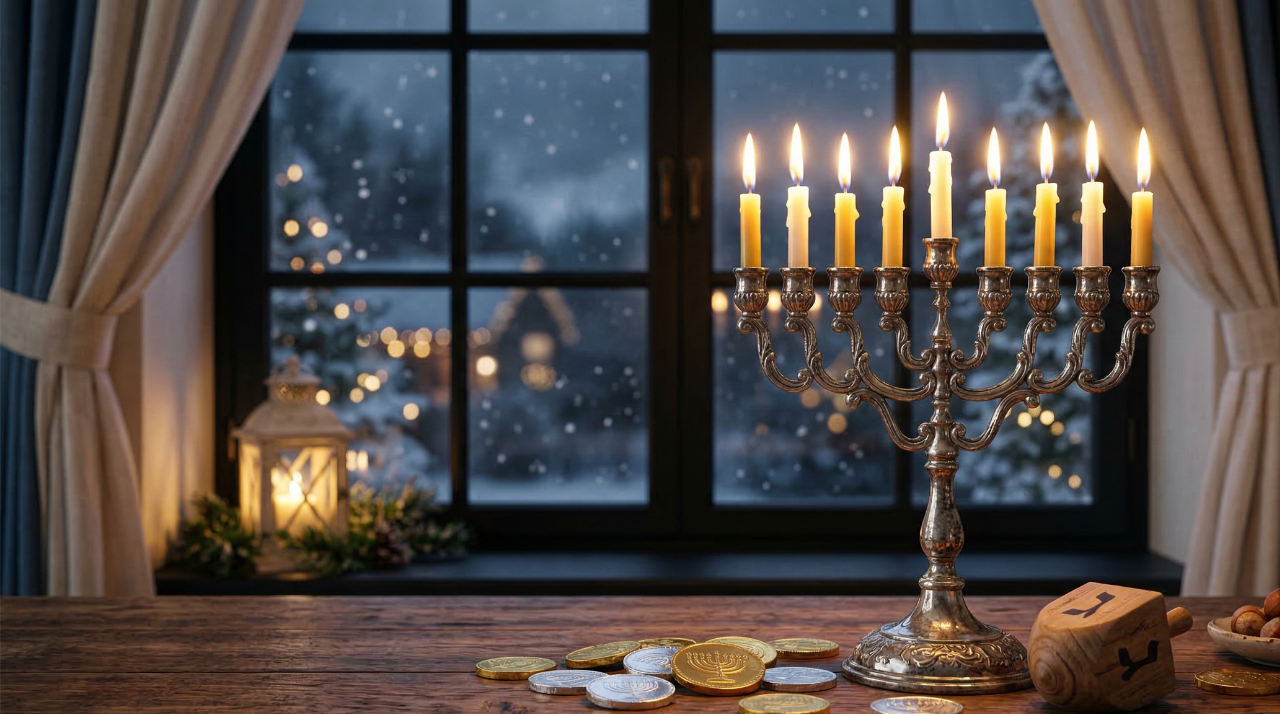
This is the undeniable centerpiece of the entire holiday. The traditional Hanukkah menorah incredibly holds nine candles (eight for the days of the miracle, and one “shamash” or helper candle used strictly to violently ignite the others). One wildly anticipated additional candle is lit each consecutive night. Families gather directly around the window, passionately recite ancient Hebrew blessings, and proudly display the miraculous light to the dark outside world.
2. Consuming Deep-Fried Foods
Because the holiday strictly celebrates the intense miracle of the oil, eating heavily fried foods is a massive, highly caloric tradition! Dietary diets are entirely ignored during this week. The two absolute most popular traditional dishes are:
- Latkes: Fiercely crispy, deeply satisfying fried potato pancakes perfectly served violently hot with sweet applesauce or rich sour cream.
- Sufganiyot: Massively popular deep-fried, pillowy jelly donuts completely coated in thick powdered sugar.
3. The Dreidel Game & Gelt
Children traditionally play highly competitive gambling games with a four-sided spinning top called a dreidel. Each exact side features a distinct Hebrew letter violently signifying the phrase “A Great Miracle Happened There.” The screaming children fiercely compete to win large pots of “gelt” (shiny foil-wrapped chocolate coins).
Hanukkah 2026 Ultimate Gift Guide
While massive gift-giving was not historically a major part of the ancient holiday, modern contemporary Hanukkah celebrations loudly often involve giving small, highly thoughtful gifts, books, or clever games to children on each of the incredible eight nights. If you are desperately searching for ideas for Hanukkah 2026, here are our premium suggestions:
- Night 1 (The Big Gift): Start the festival aggressively with the most highly anticipated item, like a brand-new video game console, premium wireless headphones, or a highly requested LEGO set.
- Night 2 (Educational Books): Fiercely promote extreme literacy by gifting a stack of compelling graphic novels, massive sci-fi thrillers, or a brand new Kindle e-reader.
- Night 3 (Pajamas & Comfort): A widely popular modern tradition is fiercely gifting matching family holiday pajamas or ultra-soft massive fleece blankets.
- Night 4 (Board Games): Completely force strict family bonding time with modern competitive board games like Settlers of Catan, Ticket to Ride, or Exploding Kittens.
- Night 5 (Experiences): Stop aggressively buying plastic junk. Gift intense concert tickets, a chaotic escape room voucher, or a massive family zoo membership.
- Night 6 (Charitable Giving): Teach intense moral gratitude. Help your children actively select a charity to fiercely donate their own dedicated money to this specific year.
- Night 7 (Creative Arts): Heavily supply massive art kits, blank canvas boards, high-quality markers, or wild science experiment boxes.
- Night 8 (The Grand Finale): Close the massive holiday with a bang—something highly memorable like a dedicated weekend family trip or a highly coveted pair of premium sneakers.
Plan the Rest of Your December Holidays
December 2026 is universally going to be an incredibly chaotic, massively busy month for intense holiday parties, chaotic winter travel, and aggressive gift-giving. Once the glorious Hanukkah menorah is finally put safely away on December 12th, the intense end-of-year holiday rush officially begins!
Make sure your personal family calendar is completely up to date by actively checking out our massive, complete guides to Christmas 2026 and New Year’s Eve 2026 to strictly map out your chaotic winter travel plans before the flights instantly sell out!
Frequently Asked Questions (FAQ)
When does Hanukkah start and end in 2026?
Hanukkah 2026 officially starts at sundown on Friday, December 4, 2026. The eight-day festival completely ends exactly at nightfall on Saturday, December 12, 2026.
Is Hanukkah a federal holiday in the United States?
No, Hanukkah is absolutely not a federal public holiday. All major commercial banks, the USPS, and federal government buildings will remain completely open and operational under normal standard weekday business hours.
Why do Hanukkah dates strictly change every year?
Hanukkah strictly follows the ancient lunar-based Hebrew calendar, predictably always starting on the 25th of Kislev. Because this lunar calendar deeply does not perfectly sync with the standard 365-day Gregorian solar calendar used globally, the precise physical dates widely shift every single year.